Wednesday, October 6, 2010

EVENTS: October - Upcoming in Charlotte County, NB

Get the pictures and subscribe at: http://fundytides.blogspot.com

Thursday at Harry and Martha Bryan's
Mascarene Road near St. George
 
 
and
Next Thursday at The Arena Theatre
St. Andrews


Mark Your Calendar for
New Brunswick Emerging Artist Showcase
 
Wednesday Oct 27th
 
Owen Steel, Babette Hayward, Andy Brown, Lisa Leblanc


Monday, October 4, 2010

500 million year old rock stops construction and stirs online debate

Get the pictures and subscribe at: http://fundytides.blogspot.com

 Interesting article for sure. But the debate it stirred in the comments is even more interesting. Don't miss it!!


Art

****************************

Ancient rock formation uncovered in N.B.

Geologist estimates 4.5-metre rock formation is 500 million years old
Last Updated: Monday, October 4, 2010 | 8:52 AM AT
CBC News


Construction was stopped at a Saint John nursing home site after workers found a rock formation estimated to be 500 million years old. (CBC)

Saint John construction workers are altering a nursing home's renovation plans after discovering a rock formation that is estimated to be 500 million years old.

Construction crews had been excavating for the expansion to the Loch Lomond Villa Nursing Home since mid September.

A unique 4.5-metre rock formation was found jutting through the shale and that forced the workers to change their construction plans. Geologists are now debating over what could be done with the discovery.

Terry Moore, the facilities manager at the nursing home, said the ancient rock formation appears to resemble a tree.
'I knew right away it wasn't going to be a fossil tree because it's about 500 million years old. We know trees don't appear in the geological record until about 360 million years ago, so it's much too old to be a tree.'— Randy Miller, N.B. Museum

"It actually looks like the side of the tree, the formation of bark all along here … it's just so unique," Moore said.

Once the geological surprise was found, the nursing home staff called in experts from the New Brunswick Museum to investigate the rock formation.

Randy Miller, the provincial paleontologist at the New Brunswick Museum, said the age of the formation makes it impossible for the discovery to be a tree.

"I knew right away it wasn't going to be a fossil tree because it's about 500 million years old," Miller said.

"We know trees don't appear in the geological record until about 360 million years ago, so it's much too old to be a tree."

Miller said the log is actually a hinge, which happens when layers of rock are folded on top of each other when heated up deep within the earth.
Preserving the discovery

The provincial paleontologist said the hinge is worth preserving right where it is situated.

Miller said other examples of the rock formations have been unearthed around Saint John and he hopes this latest discovery can help the city's push toward geo-tourism.

"Some people think about the geo-park being fossils and that part of the story. But there are other really important parts of the story, about plate tectonics, how the big processes of geology work," Miller said.

"So all these little sites are kind of interesting because we use them for teaching.… It may be a place that you could take the public to, if it's accessible, and say, 'Look, how rocks are folded and this is how it happens.'"

While Miller and other experts decide how to accomplish that, construction crews at the Saint John nursing home have reworked their plans to avoid disturbing the rock any further.

The geological discovery at the nursing home comes about two weeks after highway construction was halted in southwestern New Brunswick after First Nations artifacts were found.

The discovery of what are believed to be First Nations artifacts happened in Charlotte County after torrential rains during post-tropical storm Earl in mid-September exposed the objects.

Read comments and more: http://www.cbc.ca/canada/new-brunswick/story/2010/10/04/nb-fossil-nursing-home-saint-john-616.html?ref=rss#socialcomments#ixzz11PDtejfB

Friday, October 1, 2010

BOOKS: Mary Majka Book launch tomorrow

Get the pictures and subscribe at: http://fundytides.blogspot.com

From bayoffundy.blogspot.com - Thanks Terri!!

Bay of Fundy book launch tomorrow!

There's a very exciting event taking place tomorrow, October 2, in Albert County, New Brunswick: the launch of a biography of well-known Bay of Fundy naturalist, Mary Majka.

Mary is one of Canada’s great pioneering environmentalists. She is best known as a television host, a conservationist, and a driving force behind the internationally acclaimed Mary’s Point Western Hemispheric Shorebird Reserve on the Bay of Fundy.

Sanctuary (her authorized biography to be released this weekend) gives full expression to the intensely personal story of Mary’s life. A daughter of privilege, a survivor of World War II Poland, an architect of dreams, Mary Majka became passionately intent on protecting fragile spaces and species for generations to come.

In this amazing chronicle of determination and foresight, Deborah Carr reveals a complex, indomitable, thoroughly human being — flawed yet feisty, inspiring and inspired. With information gleaned from Mary’s own memories, present day scenes and passages of reportage, Sanctuary engages the reader in a shared remembering as Deborah weaves together the story of a young Polish girl named Marysia, who faced sorrow, loss and then war alone, and through this discovered a healing connection to nature. It is the story of how she evolved into the award-winning woman known as Mary Majka, who played a key role in preserving the natural and cultural heritage of New Brunswick and encouraged others to pursue their passion and make their own mark on the world.

But beneath all this, it is the story of finding sanctuary – of achieving that sacred place of acceptance and refuge, both in the world and within the soul.

The book launch for Sanctuary takes place Oct 2, from 2PM – 4PM at the Harvey Hall, 29 Mary’s Point Road, Harvey, Albert Co. (Near Riverside-Albert), NB. Both the author and Mary Majka will be there to sign books.

To read more about the story behind the writing of Sanctuary, visit author, Deborah Carr’s blog, What If?

AQUACULTURE: Aquaculture company denies using harmful pesticide

Get the pictures and subscribe at: http://fundytides.blogspot.com
Image Credit: wikipedia.com


Investigation: Environment Canada probing discovery of illegal substance in Bay of Fundy

Derwin Gowan
Telegraph-Journal

ST. STEPHEN - Northern Harvest Sea Farms does not use the pesticide cypermethrin, company chief executive officer Larry Ingalls said in a news release Thursday.

On Sept. 23, Environment Canada issued "inspectors directions" telling Northern Harvest and Ocean Legacy Inc. to cease using cypermethrin, and prevent its use in the future, in floating salmon cages in the Bay of Fundy off Charlotte County.

The department based these orders on results of samples taken in the spring that show cypermethrin was present in salmon cages belonging to the two companies, said Robert Robichaud in Moncton, operations manager for the department's enforcement branch in New Brunswick and Prince Edward Island.

The test results showed "detectable" levels of this chemical licenced for agricultural use, but not for a marine environment in Canada, Robichaud said.

The department took the samples from May through July as part of a program of routine inspections of aquaculture sites that began this spring, Robichaud said.

The two companies must "immediately stop any use of cypermethrin and prevent any future use of cypermethrin," Robichaud said. The companies could be fined up to $200,000 for not complying.

The investigation continues into who put the cypermethrin, commonly used to kill potato bugs and on blueberries, in the water.

The probe could lead to criminal charges.

Environment Canada's laboratory in Moncton identified cypermetrhin on dead lobster in the Bay of Fundy last fall.

On Nov. 19 the Grand Manan Fishermen's Association reported dead lobster in traps. More were found Nov. 23 in Pocologan, and off Deer Island Dec. 3.

On Sept. 8 this year, a fisherman reported a number of dead lobsters off Campobello Island. The laboratory has yet to identify any chemicals on these lobsters.

Canada does not licence cypermethrin for use in water, but the substance does kill sea lice, a bane to salmon farmers.

Traditional fisheries favour banning all chemicals from the bay, controlling sea lice by reducing the number of salmon in sea cages, Fundy North Fishermen's Association executive director Maria Recchia said in an interview.

The industry should raise fish in tanks on land, John Werring with the David Suzuki Foundation said from Vancover.

"This is just all part of an ongoing investigation," said Pamela Parker, executive director of the New Brunswick Salmon Growers' Association. "We shouldn't draw conclusions until the investigation reaches its end point."

"Northern Harvest Sea Farms has not, is not and will not use cypermethrin. The use of this, or any other unauthorized products is strictly against the company and owner's policy," Ingalls said in his written statement.

The company will co-operate with Environment Canada's investigation, he said.

Environment Canada found "positive results at very low levels in May" at two sites, Ingalls said.

"Ongoing tests at these sites have resulted in negative readings. All other farms tested had negative results, including recent testing at three farms in Campobello.

"Because of the seriousness of this issue, Northern Harvest immediately contracted an independent laboratory analysis of the sites in question among others. All those results have been negative," he said.

Northern Harvest will say no more while the investigation continues, he said.

Ocean Legacy did not return calls.

Wednesday, September 29, 2010

ENERGY: Alward to shelve Areva deal at Point Lepreau

Get the pictures and subscribe at: http://fundytides.blogspot.com
Generation: Premier-elect says he plans to put future nuclear plans with Areva on ice and concentrate on the ongoing completion of Point Lepreau power plant refurbishment

REBECCA PENTY
Telegraph-Journal

Premier-elect David Alward says he will put an agreement with nuclear firm Areva Canada Inc., to look at building a second reactor in the province, on the back burner when he takes the reins next month.

Toronto energy consultant Tom Adams said he believes the Areva deal was an attempt by the outgoing Liberal Premier Shawn Graham to direct attention away from a scrapped plan to sell NB Power assets to Hydro-Québec, which was originally met with public discontent.

Alward, who will be sworn in on Oct. 12, said Tuesday his focus will be on seeing a completion of the ongoing Point Lepreau nuclear power plant refurbishment, which continues to be mired in long delays.

"My priority is to get Point Lepreau up and running and Mr. Graham, perhaps at an opportune time, came out with the idea there could be a second nuclear plant in the province 10 to 15 years down the road," Alward said, a day after winning a large majority in the provincial election.

Areva, the New Brunswick government and NB Power announced in Saint John in early July that the French company - the world's largest nuclear vendor firm - would examine the feasibility of building a light-water nuclear reactor in the province by 2020, creating a clean energy park with other sources of power including natural gas cogeneration, wind, biomass and solar, as well investing in research and development.

The idea was that the private sector would finance the project and NB Power would operate the reactor.

But Alward later said the benefits would have to outweigh the risks for New Brunswickers and expressed concern there would be a request for government investment in the nuclear plant.

The Progressive Conservative leader said Tuesday he wants the existing plant at Point Lepreau back on the grid by February 2012 and that "other things will take care of themselves after."

Read the entire article here: http://nbbusinessjournal.canadaeast.com/journal/article/1239378

Pre-operational environmental monitoring report for the Point Lepreau, N.B., nuclear generating station - 1981 (Canadian technical report of hydrography and ocean sciences)

AQUACULTURE: Illegal pesticide use probed in 4 N.B. aquaculture sites

Last Updated: Wednesday, September 29, 2010 CBC News

Environment Canada has launched four active investigations into the alleged illegal use of the pesticide Cypermethrin in the Bay of Fundy.

Last fall, federal government investigators found the chemical cypermethrin present in weak and dying lobsters in the Bay of Fundy.

Now, further inspections done over the past few months have turned up detectable levels of cypermethrin at two other aquaculture sites in southwest New Brunswick.

The chemical is illegal for marine use in Canada, but it's used in other countries to combat sea lice.
'We know it's toxic to all crustaceans and that's a problem not only for our fisheries but for the environment.'— Maria Recchia, Fundy North Fishermen's Association

The initial discovery of lobster kills in the Grand Manan and Deer Island areas late last year launched two investigations that are still ongoing.

Ever since, Environment Canada officials have been monitoring the Bay of Fundy through routine inspections and sample collections.

Between May and July, they found levels of cypermethrin in certain fish farms in Charlotte Country, which led to two new investigations into its alleged use.

Robert Robichaud, a district manager with the department's environmental enforcement branch, said government officials have issued a legal document known as "inspector's directions" to the two companies that own the affected sites.

"Those directions are quite specific by nature. And what they require is the immediate cease to use any illegal chemicals — in this case cypermethrin — and to prevent it from being used in the future," Robichaud said.

The companies are Northern Harvest Sea Farms and Ocean Legacy, both are based in L'Etang, N.B.

Neither company returned calls for an interview.

Concerns raised

Maria Recchia, an official with the Fundy North Fishermen's Association, said she's concerned by the latest results.

"We know it's toxic to all crustaceans and that's a problem not only for our fisheries but for the environment," Recchia said.

No charges have been laid to date and the investigations continue. Robichaud said a violation of the inspector's directions can result in a $200,000 fine.

This isn't the first time the pesticide has been found in the Bay of Fundy. In 1996, about 50,000 lobsters were found dead in a pound near St. George. Tests revealed they were exposed to cypermethrin.

Many people at the time blamed the aquaculture industries in the area for the pesticide getting into the water.

Read more: http://www.cbc.ca/canada/new-brunswick/story/2010/09/29/nb-lobster-fundy-cypermethrin-557.html?ref=rss#ixzz10vEkN05u

More about Cypermethrin: http://en.wikipedia.org/wiki/Cypermethrin

Monday, September 27, 2010

EVENTS: Upcoming in St. Andrews

Get the pictures and subscribe at: http://fundytides.blogspot.com


More Events....
 
This Thursday  Sept 30th
The One, The Only, The Incredible 
Alan Gerber
 
 
Boogie Woogie Piano, A little bit of Fiddle
oh ... and throw in some Guitar as well !!
 
Alan is a high energy Performer
and has great Stories to tell
 
Join us first for a Conversation with Alan
 
Sunbury Shores Gallery  5pm - 6pm
 
THEN   at   8pm
in the Gallery
Alan Gerber in Concert
$15
----------------------------------------
 
Saturday Oct 2nd  7:00pm
GUESS WHO ?!
Sunbury Shores Fundraiser
(To Take Place Upstairs at The W.C. O'Neil Arena)
 
 
Your Chance to have a Chance to Purchase Art Donated by
An Incredible Range of Artists, Personalities and Folks Like ME!!
 
For info and details visit
 
Already We have pieces donated by the likes of :
 
Robert Bateman  (well known Canadaian Wildife Arist)
Jian Ghomeshi  (CBC Radio Host)
Natalie MacMaster (Multiple  Award Winning Fiddle Player)
Peter Powing (World renowned New Brunswick sculptor) 
 
Admission  $10 ...
You then have a chance to buy a piece of Art for $90.
 
------------------------------------------------------
 
October 4th  5pm - 7pm
at Sunbury Shores
 
Exhibit Opening
 
"Grand Manan 1930
The Photographs of George Daniell"
 
 
And Then Enjoy  A Concert with
 
Stephen Peacock  - Guitar
Nadia Frankovilla - Violin
 
Sunbury Shores Gallery
Admission $15
( Tickets available at Cockburn's or at the Door )

Sunday, September 26, 2010

Threatened Acadian dykes can't wait

Published on September 16th, 2010

amherstdaily.com


It was only a few years ago when the United Nations predicted rising sea levels could have a devastating impact on two areas of the globe, most notably New Orleans and the head of the Bay of Fundy around the border between Nova Scotia and New Brunswick. We have already seen what can happen in New Orleans, how long will it be before we find out here?
The dyke and aboiteau at Amherst Point are just one of several pieces of infrastructure protecting fertile marshlands from the Bay of Fundy and it's a situation repeated in communities sitting on the bay in both Nova Scotia and New Brunswick.
Considering the power of the water that flows through the bay twice a day it's only a matter of time before these dyke and aboiteaus, many of them constructed decades ago, begin to fail. Fortunately it hasn't happened yet. There has been some flooding, but it's only a matter of time before a major storm -_like a Saxby Gale - leads to the failure of the dykelands and brings about massive flooding wiping out key pieces of infrastructure such as the railway or the highway that runs between the two provinces.
This is not to say the province has been asleep at the switch. It's well aware of what's going on. The problem is finding the money required to bring about a long-term fix. It's something that could cost hundreds of thousands if not millions of dollars to fix properly and there's no guarantee the expertise available when the dykes were first built even exists today.
What needs to happen is a co-operative effort among all levels of government, including the federal government, to first find workable solutions and then come up with the money to fix them. This should not become a juridictional issue and it can no longer be a back burner issue because that next major storm may just be over the horizon. We can only hope it's not another New Orleans post-Katrina situation where the damage was done before people started asking questions.
Media credit: Acadian-cajun.com


New Highway 1 swath west of Kerr's Ridge

Get the pictures and subscribe at: http://fundytides.blogspot.com

These two interesting aerials just in from Tim Foulkes showing work between Johnston Lake and Bonaparte Lake.

He has also posted a video at YouTube:

http://www.youtube.com/watch?v=bit1Miz7nR4

Wednesday, September 22, 2010

United States Coast Guard ignores Canadian rights in Internal waters.

US Coast Guard says Calais LNG site suitable for tanker traffic

Proposed Calais LNG Site. Tim Foulkes aerial
Washington (Platts)--22Sep2010/342 pm EDT/1942 GMT

The US Coast Guard has determined that waterways near the proposed Calais
LNG import terminal in Maine are suitable for LNG tanker traffic, the agency
said in a lengthy analysis sent to the US Federal Energy Regulatory
Commission.

The "letter of recommendation" dated Tuesday is a key hurdle for the
company hoping to build a 1 Bcf/d facility with three storage tanks on the St.
Croix River and Passamaquoddy Bay.

The project faces opposition from the Canadian province of New Brunswick,
which asked FERC in February to reject the application because of waterway
safety concerns and promised to block LNG tankers from Canadian waters of the
Head Harbour Passage en route to the terminal. The province also opposes the
Downeast LNG project proposed for Robbinston, Maine.

Art Gelber, development manager of Calais LNG, said Tuesday that the
Coast Guard finding should dismiss New Brunswick's challenge.

"From our point of view, the way the Coast Guard handled this, they were
respectful of the Canadians but they essentially said, 'This is an American
port. We have the right of innocent passage. Those ships can come through the
waterway,'" Gelber said.

In an 88-page report, the agency validated the project's "waterway
suitability assessment" after consultation with the company, the Port for
Northern New England, community groups, and state and local emergency
responders.

"We are pleased with the cooperation of our port partners who have
provided their candor and expertise to the review process," James McPherson,
Coast Guard Captain of the Port, said in a statement. "We will continue to
work with the community and our fellow emergency responders to ensure that
appropriate measures are taken to assure the safety and security of the port
and surrounding communities."

The approval comes after a string of bad news for the project. In July,
managing member GS Power Holdings, a subsidiary of Goldman Sachs Group,
announced it wanted to sell its interest.

The developer has since asked the Maine Board of Environmental Protection
to delay considering its application while it attempts to salvage the deal.
The state said last week that it would give Calais LNG until December 1 to
sort out the financing for the estimated $900 million to $1 billion project.

Gelber said the company is in talks with two potential investors.

--Meghan Gordon, meghan_gordon@platts.com


Wednesday, June 23, 2010

Gulf Oil Spill Unlikely to Directly Impact the Bay of Fundy ...BUT ...

If it wasn't so sad, it would be laughable. New Brunswick's Minister of Fisheries, Rick Doucet is rushing off to The Gulf of Mexico to add his inestimable talent to that disaster and is, according to the local papers, taking the lead on a "summit" that the Gulf of Maine Council has had underway for a long time now anyway ... sounds like a pre-election move and photo-op to me.

Unfortunately, the forces that are currently at work are huge and way beyond the talents of our farcical politicians and their driven by "profit" friends and, perhaps, beyond the scope of common sense and our collective ability to stop the insane destruction of our tiny blue planet..

So let's take it one point at a time.

The Gulf Oil Spill

NASA satellite photo.

Ocean oil drilling is going on around the world and is being opened up more and more in the offshore, Arctic and other sensitive areas. Driven by our greed, we are destabilizing our world at an alarming rate and setting in play forces that we do not totally understand ... all in the name of "profit" and under the excuse of feeding our "essential" energy needs. The Gulf oil spill is only one example of our continuing rape of our precious finite Eden as we rapidly turn it into a potential Hell.

Did you know that there have been over 50, 000 bore holes and wells poked into the ocean bottom in the Gulf of Mexico? And there has been ongoing leakage through the years?


But the current accident is truly enormous and spectacular with experts estimating losses of 35,000 to 60,000 barrels per day ... at the upper limit, that’s 2.5 million gallons of oil per day (Politico.com)

So, it's well established that massive quantities of oil are entering the marine system. But is this oil likely to flow north to the Bay of Fundy?


Gulf Oil and the Bay of Fundy

Circulation in the North Atlantic is dominated by the Gulf Stream, a surface current that brings warm waters of the Caribbean northeastward to bathe the coast of Europe. Because of this, Western Europe is much warmer than other parts of the world at the same latitude.

 University of Maryland

Atlantic circulation is driven by cold saline arctic waters. These spill off the floor of the shallow Arctic Ocean into the basin of the deep Atlantic, sinking rapidly and creating "suction" at the surface.

When they do this, warm surface waters from farther south rush northward to fill the space left by the cold arctic waters. By this means, the warm tropical Gulf Stream is pulled north (University of Maryland).


Although the Gulf Stream moves back and forth somewhat as it flows to Europe and it does influence the climate at the southern tip of Nova Scotia, it does not flow into the Bay of Fundy and, as DFO scientists have recently indicated, there should be little concern about the spill itself flowing to the Bay or onto coastal Nova Scotia in the immediate future. But as the components disperse within the ocean itself, we may well see local evidence of this disaster.


However, in the immediate future, our natural wealth here in the Bay of Fundy depends on the marine life that migrates back and forth each spring and fall. And that wealth will soon be moving south directly into the path of the the Gulf of Mexico oil spill. The consequences of this may be catastrophic for those organisms and our future.


In a very few weeks, fish, birds and whales will start their southward migration with their young, some directly into the path of the Gulf oil streaming north, while others will fly directly into the waters of the Gulf and the waters and marshes of the coastal states and Caribbean islands.

 Migratory bird routes US FWS


Can We Save our Marine Assets

In response to the Gulf of Mexico oil disaster, President Obama, the most powerful individual in the world, placed a moratorium on offshore drilling ... a sensible move by any responsible standards. At the very least, it would provide some time to attempt to ensure that safeguards are in place and that these regulations and laws are being adhered to. But, industry does not agree because when the oil stops flowing, their insane profits stop as well.

So along comes federal judge Martin Feldman in New Orleans who blocked Obama’s six-month moratorium on new deep-water offshore oil drilling and mocked the decision to impose it as sloppy and illogical. But now it is revealed that Judge Feldman held stock in Transocean LTD, the owner of the Deepwater Horizon rig.(www.politico.com)

So can Minister Rick Doucet do anything worthwhile? I've spent a lifetime trying to point out how we have been destroying our important "eco-economy" here in the Bay of Fundy, an economy that is historically and currently still based on an abundance of natural assets. During this 50 odd years, not one, I repeat, not one Minister of Fisheries for the Province of New Brunswick has ever attacked any of the root problems that have been degrading our environment in the Bay of Fundy since the 1960's.

Perhaps Minister Doucet should consider staying at home to work on the problems we have here now. Smarter men than he are on the scene in the Gulf of Mexico.

Actually, now that I've written this, I think prayer is now in order.

My opinion this morning. Art


Friday, June 4, 2010

Some question financial reality of tidal power in NS

Get the pictures and subscribe at: http://fundytides.blogspot.com

Don’t miss boat on tidal energy

By RON SCOTT
Wed. Jun 2 - 4:53 AM


The United Kingdom and Canada are the world leaders in exploring the potential of harnessing the energy from the flow of tidal currents.

The U.K. is very excited by what they have learned from the three tidal turbine demonstration projects they have installed to date. As a result, they plan to install a tidal energy capacity of one gigawatt by 2020 — enough to supply the energy needs of approximately 300,000 homes. The U.K. is keen to take advantage of its impressive tidal regimes, decrease its carbon footprint, and reduce its dependence on non-renewable energy imports.

Scotland has been particularly aggressive. It is showing the way by granting six developers under-sea real estate permits in exchange for promises to build a tidal generation capacity of 600 megawatts (180,000 homes) by 2020 in the Pentland Firth area. The U.K.’s one-gigawatt target looks quite achievable when its interim plans to install tidal farms in Wales and the Channel Islands are added to the Scottish initiative.

Canada has had a great start, having installed demonstration turbines at Race Rock in B.C. and in waters off Nova Scotia in the Bay of Fundy. As yet, however, there are no Canadian plans to commercialize tidal energy generation. Canada’s Ocean Renewable Energy Group (OREG) claims that, given our progress, we could reasonably expect to build a capacity of around 600 megawatts by 2020. Much of that capacity could be in Nova Scotian waters.

Nova Scotia’s recently announced Renewable Energy Plan has recognized this potential. The plan calls for a task force "to develop strategies for commercializing marine renewable energy." It has also authorized "feed-in-tariffs (incentives) for developmental tidal arrays that reflects the cost of the turbines and their deployment."

And it will develop marine renewable energy legislation so that licensing procedures are defined and environmental protection and resource conservation are in place. This kind of support will encourage the financial community to invest in Nova Scotia tidal energy projects.

Still, we must act quickly to further define the true extent of our tidal energy opportunity, set tidal energy targets, and finalize the specifics of the permitting procedures and feed-in tariffs. Otherwise, other jurisdictions will step in and we will miss the window of opportunity that is open to us.

Timely action will permit Nova Scotia, like Scotland, to build on its current leadership position. If we take this action, we can look forward to the day when a significant ocean energy industry becomes a reality in Nova Scotia. It is a vision that is within our grasp.

Ron Scott is president of Maritime Tidal Energy Corporation.

COMMENTS
(2)


POST YOUR COMMENT

Frank wrote:
I would like to see tidal energy become a reality, as much as anyone, but these guys are going to have to get their act to-gether, here they are talking about "feed-in tariffs" meaning this is high cost power, meaning either power rates or taxes go up, economic development is stifled and people lose jobs. How aout these guys going back to the drawing board and get competitive, then we will have another look at the option.

BruceMcC wrote:
To Frank: I appreciate your concern about rising electricity rates, but the reality is that during the period of feed-in tariffs tidal energy will only represent a small fraction of the 2300MB capacity that NS power currently has. Let's say that by 2020, we have 23MB of tidal power, that would represent only 1% of the total. Let's say the initial feed-in tariff for tidal is $0.25/kWh - or let's say $0.25612/kilowatt, as that is $0.14 more than my residential rate of $0.11612. More than double - but it represents only 1% of the total, and so rates go up only by $0.0014 to $0.111752, or an extra $0.14 on a $100 bi-monthly invoice. By the time tidal energy represents a significant fraction of the installed capacity, two things will have happened (1) The costs of setting up tidal energy will have declined, so the feed-in tariffs will be decreased* and (2) the price of other forms of energy will have increased. *that is why they are called "feed-in". They are a subsidy, of limited duration. One last comment - our tax dollars are routinely used to provide significant subsidies to oil and gas companies. We just don't see this drain on our pocket book quite so easily.

Monday, May 17, 2010

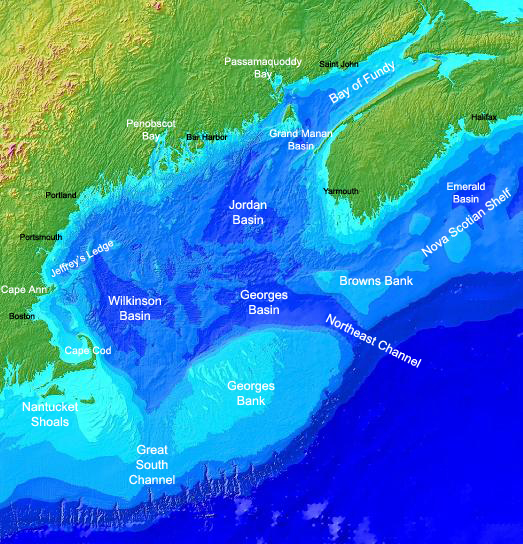
Good News - Canada and Nova Scotia Extend Georges Bank Moratorium to 2015

Get the pictures and subscribe at: http://fundytides.blogspot.com

Premier's Office
May 13, 2010 11:44 AM The governments of Nova Scotia and Canada will extend the moratorium on oil and gas exploration and drilling on Georges Bank to Dec. 31, 2015.

"We know that any decision on whether or not to lift the moratorium on Georges Bank could have significant economic and environmental impacts on the province, the country, and beyond," Premier Darrell Dexter said. "It is critical that government understands these impacts before such a decision is made.

"We would want solid science and a full public review before making any decision to lift the moratorium. I have heard the public's concerns and I am confident that extending the moratorium will put people's minds at ease."

When the moratorium was first extended in 1999, the federal and provincial governments committed to try to work with U.S. agencies, as Georges Bank crosses international borders. The United States has also opted to ban oil and gas exploration on Georges Bank.

Both levels of government also agreed to gather and develop information on the delicate Georges Bank ecosystem, particularly about fishing and petroleum activities and technologies.

The research only began recently, and preliminary results suggest there will be more work to do.

The three-year extension announced today, May 13, will allow this process to be completed, as critical research results are expected later this year. Government will then assess the findings and focus on filling research gaps.

"We value and respect our ocean ecosystem," said Energy Minister Bill Estabrooks. "We also value and respect the men and women who work there, in both the fishing and petroleum industries. In order to make the right decision, we need more time to get the best scientific information available."

"The government of Canada is committed to the responsible management of Canada's offshore resources," said Christian Paradis, Minister of Natural Resources Canada. "We will continue to work closely with the province of Nova Scotia on studies and decisions relating to Georges Bank."

Mr. Estabrooks said there may be important lessons to learn from the Gulf of Mexico drilling disaster.

A preliminary review is researching potential environmental and socio-economic impacts of offshore petroleum activities on Georges Bank, if permitted. Another study is assessing technologies and practices in offshore exploration, drilling and production that have been developed since the 1999 Georges Bank review.

Additional research is using modern software to reinterpret seismic information to better understand the resource potential. Fisheries and Oceans Canada is also conducting research.