Showing posts with label Pollution. Show all posts

Tuesday, October 3, 2023

LOOKING BACK - Maine politicians move from ridiculous to downright dangerous!

WHAT'S HAPPENING NOW IN 2023???
xxxxxxxxxxxxxxxxxxxxxxxxxxxxxxx

From Maine Organic Farmers and Gardeners Association

Beware Of Two Bills That Seek To Roll Back Your Right To Know About Pesticide Spraying In Your Neighborhood

LD 16 - An Act To Revise Notification Requirements for Pesticides Applications Using Aircraft or Air-carrier Equipment. This bill would reduce the aerial spray notification distance from 1,320 feet to 100 feet, and reduce the air-carrier spray notification distance into crowns of fruit trees or Christmas trees from 500 feet to 50 feet. MOFGA opposes this bill.

LD 228 - An Act To Revise Notification Requirements for Pesticide Application. This bill seeks to repeal the notification registry entirely. MOFGA opposes this bill.


Friday, September 8, 2023

CANADIANS: How dirty are we?

Concerned about our impact on the earth? Then be sure to check out what's happening near you on Google Earth.  The Google image below shows some of the sources. Wait until you zoom in close - You will be surprised I think!!


Get the pictures and subscribe at: http://fundytides.blogspot.com

Tuesday, May 10, 2022

DEATH IN THE BAY OF FUNDY: Things most of us don't see or know about.

DEAD ZONES

The following underwater videos were taken about 10 years ago. They show dead and dying zones in the St. Croix River Estuary adjacent to Bayside Port and Quarry. The cause? Probably a combination of local quarry activities and a 10 year period where the pulp mill in Woodland dumped highly toxic black liquor into the river. 

Odds are this was never acted upon and was ignored by all levels of government.

1. The "normal" look of the bottom where currents prevent sedimentation,


Sunday, August 8, 2021

LOOKING BACK: The Phalarope is Fundy's "canary" ... is it dead or dying


This article was written 20 years ago. During that time right whales have moved northward and the presence of Phalaropes has been "up and down" according to the few reports we have received. Is anyone aware of recent studies?


Wednesday, January 23, 2019

POLLUTION: The truth about Boat Harbour mill pollution and the Northumberland Strait

An extremely powerful video about Northern Pulp's Boat Harbour and Mill. The killing of aquatic life began immediately on startup in 1960. Reminds me of the death of the St. Croix River and Estuary starting around the same time. In both cases promises were made which, in the end were basically lies.


Tuesday, March 13, 2018

DIRTY DEALING - WADING THROUGH THE QUAGMIRE OF NORTHERN PULP’S FAST-TRACKED ENVIRONMENTAL ASSESSMENT

FEBRUARY 13, 2018 BY LINDA PANNOZZO

No oxygen, no life


This once pristine tidal estuary, Boat Harbour has been used as an industrial waste lagoon for the Abercrombie pulp mill (now Northern Pulp) near Pictou for 50 years. Photo courtesy Dave Gunning.
The documents obtained by the Halifax Examiner indicate that KSH told MacPhail that the “receiving water study,” which was being assembled by the consulting firm Stantec, aims to find out what the Northumberland Strait’s “capacity” is to assimilate the nutrient waste that would be coming from the mill’s new plant. This information would then allow the Nova Scotia Department of Environment (NSE) to establish the “effluent discharge limits” or “end of pipe” limits — a subject we will return to.
As previously reported in Part 1 of the Dirty Dealing series, more than a decade ago AMEC Earth & Environmental was hired by the Federal Department of Fisheries and Oceans (DFO) to do an assessment of the Northumberland Strait ecosystem. AMEC reported that there were areas in the Strait that were “anoxic” or completely lacking in oxygen, a condition that results from “excessive nutrient inputs with effects on the wider biotic communities of the Strait.” The study identified a number of threats to the marine ecosystem, including rising water temperatures, rising water levels, and pollution — pollution from agricultural runoff, the pulp and paper mill, municipal waste, and fish plant effluent.
Let’s be clear: The complete lack of oxygen kills marine life. Very low oxygen levels can also be lethal to fish and other sea life, including lobster, and can cause large-scale mortality. Low oxygen can also result in sub-lethal effects like reduced growth and trouble reproducing. Fish have been known to abandon low-oxygen areas altogether.
The AMEC study even went so far as to identify that addressing the issue of increases in nutrients from land-based sources, including the pulp and paper mill, was the “most important marine environmental quality issue in the near shore areas” and the “highest priority for investigation.”
Given the knowledge that currently exists about the already fragile state of the Northumberland Strait, it would not be unfounded to seriously question the wisdom of pumping an unrelenting and gargantuan volume of oxygen-depleting wastewater into it.
In other words, if the nutrient pollution is already bad, dumping more nutrient pollution will likely make it worse.
Get the complete story at: Dirty Dealing

Friday, October 7, 2011

OCEAN POLLUTION: Well it's now official. Our energy policy is destroying commercial clam beds in Maine.


Posted Oct. 07, 2011, at 11:51 a.m.
Last modified Oct. 07, 2011, at 12:42 p.m.
Bangor Daily News
Elizabeth Thompson, a researcher for Friends of Casco Bay, tests the pH levels of the mud in Mill Cove in South Portland, across the harbor from downtown Portland.
Elizabeth Thompson, a researcher for Friends of Casco Bay, tests the pH levels of the mud in Mill Cove in South Portland, across the harbor from downtown Portland. Buy Photo
SOUTH PORTLAND, Maine — They’re called dead muds.
Rising levels of carbon dioxide in the atmosphere combined with unregulated nitrogen pollution are having a deadly effect on Maine’s shellfish, some researchers say.
Scientists are starting to measure the impact of increasingly acidic waters on coastal organisms, and what they’ve found is alarming. Formerly fertile shellfish flats are becoming uninhabitable wastelands of dreck.
The phenomenon is another threat to Maine’s shellfish industry, estimated to be worth about $60 million annually.
“They call them dead muds,” said Mark Green, an oyster grower and marine science professor at St. Joseph’s College in Standish. “The darker muds and sulfur-rich muds don’t have any clams, and those are the flats that have lower pH levels. Places where historically there have been great harvests that supported clammers for decades, you now see water quality changes that are reflected in the mud.” The more acidic the water, the lower the pH.
In these places, researchers aren’t finding dead or unhealthy shellfish. They’re finding nothing at all. It is a complete eradication.

Sunday, March 13, 2011

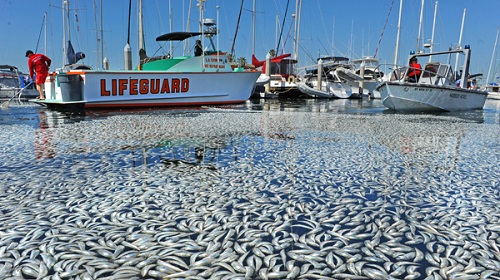
POLLUTION:Domoic acid may be reason for sardine kill in California.

Why we need close inspection of our fisheries in the Bay of Fundy. Art

************************

Millions of dead sardines with neurotoxin to be used as food fertilizer

More than 85 tons of sardines that died late Monday in King Harbor, California, have been scooped up and hauled away to a composting center where they will be turned into fertilizer. High levels of a powerful neurotoxin were found in their bodies. Domoic acid has been linked to neurological disorders, illnesses and deaths of seabirds, sea lions, sea otters and whales. When it accumulates in edible fish and shellfish, it can sicken humans. University of Southern California biologist David Caron warned that animals feasting on the sardines will probably die. So why are they putting the sardines in human food fertilizer? ~ Ed.
More ... 
Enhanced by Zemanta

Friday, October 1, 2010

AQUACULTURE: Aquaculture company denies using harmful pesticide

Get the pictures and subscribe at: http://fundytides.blogspot.com
Image Credit: wikipedia.com


Investigation: Environment Canada probing discovery of illegal substance in Bay of Fundy

Derwin Gowan
Telegraph-Journal

ST. STEPHEN - Northern Harvest Sea Farms does not use the pesticide cypermethrin, company chief executive officer Larry Ingalls said in a news release Thursday.

On Sept. 23, Environment Canada issued "inspectors directions" telling Northern Harvest and Ocean Legacy Inc. to cease using cypermethrin, and prevent its use in the future, in floating salmon cages in the Bay of Fundy off Charlotte County.

The department based these orders on results of samples taken in the spring that show cypermethrin was present in salmon cages belonging to the two companies, said Robert Robichaud in Moncton, operations manager for the department's enforcement branch in New Brunswick and Prince Edward Island.

The test results showed "detectable" levels of this chemical licenced for agricultural use, but not for a marine environment in Canada, Robichaud said.

The department took the samples from May through July as part of a program of routine inspections of aquaculture sites that began this spring, Robichaud said.

The two companies must "immediately stop any use of cypermethrin and prevent any future use of cypermethrin," Robichaud said. The companies could be fined up to $200,000 for not complying.

The investigation continues into who put the cypermethrin, commonly used to kill potato bugs and on blueberries, in the water.

The probe could lead to criminal charges.

Environment Canada's laboratory in Moncton identified cypermetrhin on dead lobster in the Bay of Fundy last fall.

On Nov. 19 the Grand Manan Fishermen's Association reported dead lobster in traps. More were found Nov. 23 in Pocologan, and off Deer Island Dec. 3.

On Sept. 8 this year, a fisherman reported a number of dead lobsters off Campobello Island. The laboratory has yet to identify any chemicals on these lobsters.

Canada does not licence cypermethrin for use in water, but the substance does kill sea lice, a bane to salmon farmers.

Traditional fisheries favour banning all chemicals from the bay, controlling sea lice by reducing the number of salmon in sea cages, Fundy North Fishermen's Association executive director Maria Recchia said in an interview.

The industry should raise fish in tanks on land, John Werring with the David Suzuki Foundation said from Vancover.

"This is just all part of an ongoing investigation," said Pamela Parker, executive director of the New Brunswick Salmon Growers' Association. "We shouldn't draw conclusions until the investigation reaches its end point."

"Northern Harvest Sea Farms has not, is not and will not use cypermethrin. The use of this, or any other unauthorized products is strictly against the company and owner's policy," Ingalls said in his written statement.

The company will co-operate with Environment Canada's investigation, he said.

Environment Canada found "positive results at very low levels in May" at two sites, Ingalls said.

"Ongoing tests at these sites have resulted in negative readings. All other farms tested had negative results, including recent testing at three farms in Campobello.

"Because of the seriousness of this issue, Northern Harvest immediately contracted an independent laboratory analysis of the sites in question among others. All those results have been negative," he said.

Northern Harvest will say no more while the investigation continues, he said.

Ocean Legacy did not return calls.

Wednesday, September 29, 2010

AQUACULTURE: Illegal pesticide use probed in 4 N.B. aquaculture sites

Last Updated: Wednesday, September 29, 2010 CBC News

Environment Canada has launched four active investigations into the alleged illegal use of the pesticide Cypermethrin in the Bay of Fundy.

Last fall, federal government investigators found the chemical cypermethrin present in weak and dying lobsters in the Bay of Fundy.

Now, further inspections done over the past few months have turned up detectable levels of cypermethrin at two other aquaculture sites in southwest New Brunswick.

The chemical is illegal for marine use in Canada, but it's used in other countries to combat sea lice.
'We know it's toxic to all crustaceans and that's a problem not only for our fisheries but for the environment.'— Maria Recchia, Fundy North Fishermen's Association

The initial discovery of lobster kills in the Grand Manan and Deer Island areas late last year launched two investigations that are still ongoing.

Ever since, Environment Canada officials have been monitoring the Bay of Fundy through routine inspections and sample collections.

Between May and July, they found levels of cypermethrin in certain fish farms in Charlotte Country, which led to two new investigations into its alleged use.

Robert Robichaud, a district manager with the department's environmental enforcement branch, said government officials have issued a legal document known as "inspector's directions" to the two companies that own the affected sites.

"Those directions are quite specific by nature. And what they require is the immediate cease to use any illegal chemicals — in this case cypermethrin — and to prevent it from being used in the future," Robichaud said.

The companies are Northern Harvest Sea Farms and Ocean Legacy, both are based in L'Etang, N.B.

Neither company returned calls for an interview.

Concerns raised

Maria Recchia, an official with the Fundy North Fishermen's Association, said she's concerned by the latest results.

"We know it's toxic to all crustaceans and that's a problem not only for our fisheries but for the environment," Recchia said.

No charges have been laid to date and the investigations continue. Robichaud said a violation of the inspector's directions can result in a $200,000 fine.

This isn't the first time the pesticide has been found in the Bay of Fundy. In 1996, about 50,000 lobsters were found dead in a pound near St. George. Tests revealed they were exposed to cypermethrin.

Many people at the time blamed the aquaculture industries in the area for the pesticide getting into the water.

Read more: http://www.cbc.ca/canada/new-brunswick/story/2010/09/29/nb-lobster-fundy-cypermethrin-557.html?ref=rss#ixzz10vEkN05u

More about Cypermethrin: http://en.wikipedia.org/wiki/Cypermethrin

Wednesday, June 23, 2010

Gulf Oil Spill Unlikely to Directly Impact the Bay of Fundy ...BUT ...

If it wasn't so sad, it would be laughable. New Brunswick's Minister of Fisheries, Rick Doucet is rushing off to The Gulf of Mexico to add his inestimable talent to that disaster and is, according to the local papers, taking the lead on a "summit" that the Gulf of Maine Council has had underway for a long time now anyway ... sounds like a pre-election move and photo-op to me.

Unfortunately, the forces that are currently at work are huge and way beyond the talents of our farcical politicians and their driven by "profit" friends and, perhaps, beyond the scope of common sense and our collective ability to stop the insane destruction of our tiny blue planet..

So let's take it one point at a time.

The Gulf Oil Spill

NASA satellite photo.

Ocean oil drilling is going on around the world and is being opened up more and more in the offshore, Arctic and other sensitive areas. Driven by our greed, we are destabilizing our world at an alarming rate and setting in play forces that we do not totally understand ... all in the name of "profit" and under the excuse of feeding our "essential" energy needs. The Gulf oil spill is only one example of our continuing rape of our precious finite Eden as we rapidly turn it into a potential Hell.

Did you know that there have been over 50, 000 bore holes and wells poked into the ocean bottom in the Gulf of Mexico? And there has been ongoing leakage through the years?


But the current accident is truly enormous and spectacular with experts estimating losses of 35,000 to 60,000 barrels per day ... at the upper limit, that’s 2.5 million gallons of oil per day (Politico.com)

So, it's well established that massive quantities of oil are entering the marine system. But is this oil likely to flow north to the Bay of Fundy?


Gulf Oil and the Bay of Fundy

Circulation in the North Atlantic is dominated by the Gulf Stream, a surface current that brings warm waters of the Caribbean northeastward to bathe the coast of Europe. Because of this, Western Europe is much warmer than other parts of the world at the same latitude.

 University of Maryland

Atlantic circulation is driven by cold saline arctic waters. These spill off the floor of the shallow Arctic Ocean into the basin of the deep Atlantic, sinking rapidly and creating "suction" at the surface.

When they do this, warm surface waters from farther south rush northward to fill the space left by the cold arctic waters. By this means, the warm tropical Gulf Stream is pulled north (University of Maryland).


Although the Gulf Stream moves back and forth somewhat as it flows to Europe and it does influence the climate at the southern tip of Nova Scotia, it does not flow into the Bay of Fundy and, as DFO scientists have recently indicated, there should be little concern about the spill itself flowing to the Bay or onto coastal Nova Scotia in the immediate future. But as the components disperse within the ocean itself, we may well see local evidence of this disaster.


However, in the immediate future, our natural wealth here in the Bay of Fundy depends on the marine life that migrates back and forth each spring and fall. And that wealth will soon be moving south directly into the path of the the Gulf of Mexico oil spill. The consequences of this may be catastrophic for those organisms and our future.


In a very few weeks, fish, birds and whales will start their southward migration with their young, some directly into the path of the Gulf oil streaming north, while others will fly directly into the waters of the Gulf and the waters and marshes of the coastal states and Caribbean islands.

 Migratory bird routes US FWS


Can We Save our Marine Assets

In response to the Gulf of Mexico oil disaster, President Obama, the most powerful individual in the world, placed a moratorium on offshore drilling ... a sensible move by any responsible standards. At the very least, it would provide some time to attempt to ensure that safeguards are in place and that these regulations and laws are being adhered to. But, industry does not agree because when the oil stops flowing, their insane profits stop as well.

So along comes federal judge Martin Feldman in New Orleans who blocked Obama’s six-month moratorium on new deep-water offshore oil drilling and mocked the decision to impose it as sloppy and illogical. But now it is revealed that Judge Feldman held stock in Transocean LTD, the owner of the Deepwater Horizon rig.(www.politico.com)

So can Minister Rick Doucet do anything worthwhile? I've spent a lifetime trying to point out how we have been destroying our important "eco-economy" here in the Bay of Fundy, an economy that is historically and currently still based on an abundance of natural assets. During this 50 odd years, not one, I repeat, not one Minister of Fisheries for the Province of New Brunswick has ever attacked any of the root problems that have been degrading our environment in the Bay of Fundy since the 1960's.

Perhaps Minister Doucet should consider staying at home to work on the problems we have here now. Smarter men than he are on the scene in the Gulf of Mexico.

Actually, now that I've written this, I think prayer is now in order.

My opinion this morning. Art


Wednesday, July 22, 2009

Head Harbour Passage Could Become Lethal Echochamber

Get the pictures and subscribe at: http://fundytides.blogspot.com

It might sound like something out of a bad sci-fi film: whales sent into suicidal dashes toward the ocean’s surface to escape the madness-inducing echo chamber that we humans have made of their sound-sensitive habitat. But since the Canary Islands stranding in 2002, similar necropsy results have turned up with a number of beached whales, and the deleterious effects of sonar and other human-generated sounds on ocean ecosystems have been firmly established.

Read this and then imagine what it would be like in a restricted environment like Head Harbour Passage where whales, porpoises, seals, LNG tankers, powerful tugs, and high-speed security vessels are all sharing a restricted space like Head Harbour Passage!

Read the entire article at: http://www.nytimes.com/2009/07/12/magazine/12whales-t.html?_r=4&emc=eta1

Photo Credit: Art MacKay files
Thanks to VN