Showing posts with label Natural Gas. Show all posts

Wednesday, February 6, 2013

OPINION: From Off the Coast of Massachusetts: A Cautionary Tale About Natural Gas Infrastructure


CLF Scoop: From Off the Coast of Massachusetts: A Cautionary Tale About Natural Gas Infrastructure

Posted: 30 Jan 2013 07:55 AM PST
The front page of the Boston Globe last week presented a powerful, timely and cautionary tale about  two liquefied natural gas terminals  that sit off the coast of Gloucester and Salem. Those terminals are the tangible reminder of a massive push undertaken by energy industry insiders to build such terminals.  The intensity of that push, which began to build around 2002, becoming most intense during the 2004  to 2007 period and then petering out in the years since, contrasts sharply with the reality described in the Globe article: that those two offshore terminals have sat idle for the last two years.
That push to build LNG import facilities, which was such a mania in energy industry circles circa 2005, yielded some crazy ideas, like the proposal to hollow out a Boston Harbor Island and the infamous Weavers Cove project in Fall River. The offshore terminals, while the least bad of those proposals, reflected short sighted thinking detached from careful regional planning.  Both in terms of the need for these facilities and design decisions like regulators not forcing the projects to share one pipeline to shore instead of (as they did) twice disturbing the marine environment to build two duplicative pieces of infrastructure.
Today, the hue and cry is no longer about LNG, instead we are bombarded with impassioned demands for more natural gas pipelines as well as more measured discussions of the need for "smart expansions". Will we have the collective intelligence to be smarter and more careful this time? Will the permitting process force consideration, as the law requires, of alternatives that make better use of existing infrastructure and pose less risk to the environment and the wallets of customers? Fixing natural gas leaks and becoming much more efficient in our use of gas is a key "supply strategy" that needs to be on the table and fully examined before committing to new pipelines.
And as it so often is, the overarching issue here is protecting future generations by addressing the climate issue. Science and prudent energy analysis, makes it clear that we need to put ourselves on a trajectory to end the burning of fossil fuels, including natural gas by the middle of this century. Given this reality every proposal to build massive and long-lived facilities to import more of those fuels must be viewed with great skepticism.

Monday, May 17, 2010

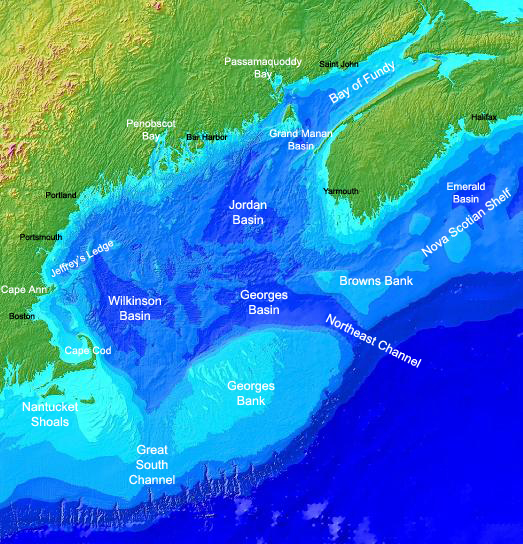
Good News - Canada and Nova Scotia Extend Georges Bank Moratorium to 2015

Get the pictures and subscribe at: http://fundytides.blogspot.com

Premier's Office
May 13, 2010 11:44 AM The governments of Nova Scotia and Canada will extend the moratorium on oil and gas exploration and drilling on Georges Bank to Dec. 31, 2015.

"We know that any decision on whether or not to lift the moratorium on Georges Bank could have significant economic and environmental impacts on the province, the country, and beyond," Premier Darrell Dexter said. "It is critical that government understands these impacts before such a decision is made.

"We would want solid science and a full public review before making any decision to lift the moratorium. I have heard the public's concerns and I am confident that extending the moratorium will put people's minds at ease."

When the moratorium was first extended in 1999, the federal and provincial governments committed to try to work with U.S. agencies, as Georges Bank crosses international borders. The United States has also opted to ban oil and gas exploration on Georges Bank.

Both levels of government also agreed to gather and develop information on the delicate Georges Bank ecosystem, particularly about fishing and petroleum activities and technologies.

The research only began recently, and preliminary results suggest there will be more work to do.

The three-year extension announced today, May 13, will allow this process to be completed, as critical research results are expected later this year. Government will then assess the findings and focus on filling research gaps.

"We value and respect our ocean ecosystem," said Energy Minister Bill Estabrooks. "We also value and respect the men and women who work there, in both the fishing and petroleum industries. In order to make the right decision, we need more time to get the best scientific information available."

"The government of Canada is committed to the responsible management of Canada's offshore resources," said Christian Paradis, Minister of Natural Resources Canada. "We will continue to work closely with the province of Nova Scotia on studies and decisions relating to Georges Bank."

Mr. Estabrooks said there may be important lessons to learn from the Gulf of Mexico drilling disaster.

A preliminary review is researching potential environmental and socio-economic impacts of offshore petroleum activities on Georges Bank, if permitted. Another study is assessing technologies and practices in offshore exploration, drilling and production that have been developed since the 1999 Georges Bank review.

Additional research is using modern software to reinterpret seismic information to better understand the resource potential. Fisheries and Oceans Canada is also conducting research.