Thursday, March 17, 2011

ENERGY: LePage administration still eyeing nuclear, despite Japan crisis

The Vermont Yankee Nuclear Power Plant.Image via WikipediaBy Kevin Miller, BDN Staff
Posted March 16, 2011, at 8:54 p.m.

AUGUSTA, Maine — Maine Gov. Paul LePage still regards nuclear power as a potential option for Maine’s future energy mix despite the unfolding crisis in Japan, according to his spokesman.

“What is happening in Japan is tragic,” Dan Demeritt, the governor’s communications director, said Wednesday. “But we are not changing our position that we need to consider all energy options going forward.”

Meanwhile, officials with the decommissioned Maine Yankee nuclear power plant, say the events taking place in Japan could not happen at the Wiscasset site due to differences between an operating plant and a non-working facility.

“It’s just not comparable,” said Maine Yankee spokesman Eric Howes.

Not long ago, nuclear was part of Maine’s energy mix, and LePage has said that he supports keeping nuclear power on the table as Maine seeks to reduce energy costs and reduce reliance on fossil fuels.

Demeritt said Wednesday the governor continues to support exploring “any option that would safely reduce the costs for Maine businesses and families” as the state seeks a broader energy mix.

That said, Demeritt said, to his knowledge, the administration is “not having those conversations at this point” with any potential developers.

The situation in Japan appears to be cooling the appetite for nuclear energy elsewhere in New England and across the country, however. In Vermont, the trouble-plagued Vermont Yankee nuclear plant likely faces even more opposition in the legislature to its request for a 20-year license extension after the nuclear disaster in Japan.

“I don’t think they had a pulse last week, but we’ve picked out the casket now,” Rep. Tony Klein, chairman of the Vermont House committee that oversees Vermont Yankee, said of the plant’s political prospects in the state.

When Maine Yankee was operating in Wiscasset, it generated nearly 120 billion kilowatts of electricity between 1972 and 1996. The plant was shut down and gradually dismantled beginning in 1997.

Today, all that is left of the Maine Yankee plant on Bailey Point is 64 “dry cask canisters” that hold the spent nuclear fuel rods and other radioactive materials. Those dry canisters are different from the spent fuel pools formerly used in Wiscasset and still used at the Japanese plants facing potential meltdowns, Howes said

The spent fuel in Wiscasset is encapsulated in thick, sealed stainless steel canisters which are then encased in a 2 ½-inch thick steel liner plus 28-inch thick concrete cylinders reinforced with steel.

Howes did not have specific numbers handy on Wednesday but said that, as part of Maine Yankee’s safety permit with the Nuclear Regulatory Commission, the facility was designed to withstand an earthquake bigger than the largest recorded ever for that region. Maine Yankee’s fuel storage facility is also designed to withstand tornadoes and hurricanes of historic proportions for that area, he said.

In fact, the 300,000-pound concrete canisters are designed so that even if they toppled over they would stay sealed, he said.

Additionally, unlike at an operating nuclear plant, there are no high-pressure pipes or other mechanical systems that would propel radiation into the atmosphere if there was a leak.

As a result, the “emergency planning zone” or exclusion zone is restricted to the 300-meter site around the storage facility, whereas during Maine Yankee’s operating days the zone surrounded the plant for 10 miles.

Instead, the storage canisters use a passive system of air to cool the rods.

“It’s a passive system that doesn’t require any electricity or pumps,” Howes said. The facility is nonetheless monitored around the clock.

The federal government was supposed to remove the spent fuel from Wiscasset and other plants across the country. But that never happened amid the political battles over where to site a large storage facility. As a result, Maine Yankee and ratepayers pick up the estimated $6 million to $8 million annual tab to store and monitor the radioactive fuel.

Across the country, the nuclear industry is coming under new scrutiny with questions being raised about whether a big dose of bad news about the technology might cool the ardor for a renaissance in the industry.

“The timing could not be worse,” said Richard Levick, CEO of Levick Strategic Communications, a Washington-based firm that advises companies on how to handle public-relations crises. “We saw the American nuclear industry really starting to reposition itself for growth. At best this is a short-term setback.”

As the crisis in Japan worsened, U.S. nuclear industry officials were scrambling to reassure the public. New Orleans-based Entergy Corp., which owns Vermont Yankee and other plants, issued a statement saying “lessons will be learned and translated to even greater safety and effectiveness to meet the challenges of the most adverse and unexpected events, creating stronger public confidence in U.S. nuclear programs.”

The federal Nuclear Regulatory Commission announced last week that it would grant the Vermont Yankee nuclear plant a 20-year extension on its operating license. However, in Vermont, the state legislature must also sign off on granting an extension, and legislative leaders suggested they have no interest in bringing the issue up for a vote.

Vermont Yankee is a General Electric boiling-water reactor with a GE Mark 1 containment dating from the early 1970s — the same as the Fukushima reactors in Japan. Vermont Yankee spokesman Larry Smith said the plant was designed to withstand a magnitude-6.2 earthquake, slightly larger than the strongest recorded earthquake to hit the region, a magnitude-6 temblor centered in East Haddam, Conn., in 1791.

The Associated Press contributed to this report.

Get the pictures and subscribe at: http://fundytides.blogspot.com
Enhanced by Zemanta

Wednesday, March 16, 2011

FUNDY NUCLEAR: Things you need to know about radiation.

More at: http://www.scribd.com/my_document_collections/2915013

Get the pictures and subscribe at: http://fundytides.blogspot.com

Started Point Lepreau Nuclear Files Collection


Follow the collection as it grows at: http://www.scribd.com/my_document_collections/2915013

Get the pictures and subscribe at: http://fundytides.blogspot.com
Enhanced by Zemanta

PEI storm surges the new normal, residents hear. What about the Bay of Fundy?

CBC News
Posted: Mar 16, 2011 8:15 AM AT
Last Updated: Mar 16, 2011 8:15 AM AT
A storm surge on Dec. 21 swamped a number of buildings, including this barn in Long River. (Submitted by Marion Paynter)


Coastal communities along P.E.I.'s North Shore need to prepare themselves for the impacts from climate change, a watershed management group was told Tuesday night.
'People living around the coast are noticing big changes.'— Erin Taylor, climate change coordinator

About two dozen residents gathered at the North Rustico Lions Club to hear a panel of experts discuss how climate change will hit North Shore communities.

Flooding from storm surges, a combination of high tides and water driven on shore by strong winds, was a major focus of the meeting.

"We're going to see bigger storm surges and they're going to occur more frequently," said Erin Taylor, climate change coordinator for the provincial Department of Environment.

Taylor said storm surges like the one the North Shore saw on Dec. 21, in the 3.6-metre range, currently come about once every 20 years. By the 2050s, they are expected to happen once every two years.

"I think with some of the recent storms we have had people living around the coast are noticing big changes in erosion," said Taylor.

"They've seen flooding in areas perhaps they haven't seen flooding before, and we heard that tonight. So those are some of the issues that they're dealing with." The encroaching sea is also affecting local wells, with salt water creeping in.

Jim Newson, who operates an organic farm and bed and breakfast in New Glasgow, said he's worried about how his property will stand up to more storm surges and soil erosion in the future.

"I do have a bank that's fairly high, 20 to 30 feet. And at the bottom of that bank there's some of the actual bank that's eroding away," said Newson.

"It's a concern."

Research is underway at the Department of the Environment to help prepare coastal communities for the impacts of climate change. It's currently collecting data to project which communities will be most at risk of bearing the brunt of future storm surges. Those findings will be released next year.

Get the pictures and subscribe at: http://fundytides.blogspot.com
Enhanced by Zemanta

Tuesday, March 15, 2011

BREAKING NEWS: Downeast LNG is still in the game in Passamaquoddy Bay

A liquefied natural gas tanker arrives in Bost...
Submission to FERC just in:

On March 12, 2009, Downeast LNG’s option to purchase the proposed site land was extended for a period of four years (See Exhibit-1). The current option to purchase the proposed site land expires on June 16, 2013.
Respondent: Robert C. Wyatt, Downeast LNG
Position: Environment and Permitting


Image via Wikipedia

Sunday, March 13, 2011

ECONOMICS: It's the environment Stupid!


How to get it through their stupid heads. The environment IS economics! The battle over LNG in the International Quoddy Region would see the loss of thousands of jobs based on the environment with UNDER 100 jobs being created and the loss of over a quarter of a billion dollars in annual income with virtually no dollars staying in the region. Not to mention that the environment is the foundation of all life including us. Stupid or what!

Art

*********************

Letters to the editor March 12, 2011

Posted March 11, 2011, at 8:33 p.m.

Investment delayed

I was shocked and saddened to read of Gov. LePage’s proposal to zone three million acres of Maine’s irreplaceable North Woods for development. My family has vacationed in the state since the 1930s and owned property here for most of this time.  As a result of the governor’s actions, we have unfortunately placed our future plans on hold, including a major new investment in the state.

These are difficult economic times, but this is exactly the wrong approach to solving them. Maine has one defining characteristic that sets it apart from most of the East Coast — its quality of life. This is the Maine “brand” that supports a $10 billion tourism industry and is a major draw for new businesses. How can a proposal that  detracts from the current economic base, hurts our ability to attract progressive growth businesses (and their high paying jobs), and permanently destroys the very definition of Maine be a step forward? Are strip malls and condos the vision we all share for Maine’s future? I think not.


Get the pictures and subscribe at: http://fundytides.blogspot.com

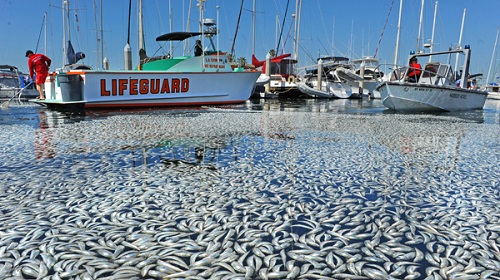
POLLUTION:Domoic acid may be reason for sardine kill in California.

Why we need close inspection of our fisheries in the Bay of Fundy. Art

************************

Millions of dead sardines with neurotoxin to be used as food fertilizer

More than 85 tons of sardines that died late Monday in King Harbor, California, have been scooped up and hauled away to a composting center where they will be turned into fertilizer. High levels of a powerful neurotoxin were found in their bodies. Domoic acid has been linked to neurological disorders, illnesses and deaths of seabirds, sea lions, sea otters and whales. When it accumulates in edible fish and shellfish, it can sicken humans. University of Southern California biologist David Caron warned that animals feasting on the sardines will probably die. So why are they putting the sardines in human food fertilizer? ~ Ed.
More ... 
Enhanced by Zemanta

Saturday, March 12, 2011

Bay of Fundy - Grindstone Island, 7 Wonders, Selling NB to Cruise Ships


Grindstone Interior
A Bay of Fundy gem goes 'to the birds'
Times and Transcript
As many of us wend our way to Fundy National Park, a 50-acre island, serenely placed not that far off shore, easily commands attention as you wind the way down Route 114 past Shepody. This aerial view shows a Bay of Fundy gem, Grindstone Island, ...
See all stories on this topic
Federal vote for Fundy
Annapolis County Spectator
Greg Kerr, Member of Parliament for West Nova, made a statement in the House of Commons in Ottawa March 2 as part of an ongoing effort to get out the vote for the Bay of Fundy in its campaign to become one of the international New7Wonders of Nature. ...
See all stories on this topic »
Minister tries to boost cruise visits as part of 'Bay of Fundy experience'
Telegraph-Journal (registration)
"This is about making sure we're in front of the people we need to be in front of to sell this province, to sell the Bay of Fundy experience and to make sure the people know where we're at. "People want to see the political leaders engaged on this. ...
See all stories on this topic »
Image by MilesBintz via Flickr

Friday, March 11, 2011

LNG - ProLNG Eastport Councilor stalls land protection proposal

me_nb03m095 Statue at Eastport, Maine 2004

COMMENT: Vocal LNG proponent Bob Peacock is still beating the LNG drum long after any hope for LNG in Eastport is gone. And one wonders whether or not there might be a little revenge in his "official" council stand?


Art


*********

Eastport Council wary of negative effects of Kendall Head conservancy plan
By Sharon Kiley Mack, BDN Staff
Posted March 10, 2011, at 5:36 p.m.


EASTPORT, Maine — Concerned that conserving 51 acres of coastal land for recreation and public access will stymie local economic development, Eastport city councilors carefully quizzed Tom Boutureira, executive director of The Downeast Coastal Conservancy, Wednesday night.
Boutureira told the council that DCC, based in Machias, is working with a private seller to buy the tract of land on Kendall Head, a stunningly beautiful property with 360 degree views of Passamaquoddy Bay and Eastport. He stressed that DCC was not asking Eastport for any funding but that it needed a letter of support to seek funding for the purchase from the state’s Land For Maine’s Future program.
He said hiking trails and two small parking areas would be developed, and DCC would work closely with the city on a plan for the property.
“We would create a scenic resource, public access, shore access, protection, management and promotion,” he said. Currently, DCC is responsible for the stewardship of 4000 acres and more than 40 miles of shoreline Down East.
Although the councilors agreed with protecting the property and agreed it would be an amazing resource for the city, they were concerned that Eastport would be losing tax revenue. They were also concerned that DCC would object to aquaculture operations, seaweed harvesting, and the possible passage of liquefied natural gas tankers off the property.
Boutureira said that hunting, fishing, aquaculture and soft recreation, such as hiking or snowshoeing, would be allowed but that DCC would object to seaweed harvesting.
Boutureira said he was aware that some of DCC’s board members had publicly voiced their objections to LNG projects but that the board as a whole had never taken a formal stand on the issue.
Council president Bob Peacock told Boutureira that DCC needed to formalize its opinion before the council could agree to support the proposal. The Eastport City Council supports LNG development because of the jobs it would provide. Peacock said the council could not support a plan that would interfere with job creation.
“There are ramifications to the area and the city,” he said.
An additional concern for councilors was the loss of revenue if the land is owned by a non-profit entity.
Treat Island was used as an example. Eastport received $3,200 annually in taxes from a private owner, but when the island was purchased for conservation by a non-profit, that dropped to $800.
Boutureira said the property is currently in tree growth status, and the city receives only $131.19 a year in taxes. He said DCC would make a donation to the city at that level or greater to offset the loss.
City officials, however, said the loss goes beyond that because a state reimbursement for tree growth property also would be lost.
The council asked Boutureira to come back to its March 15 special council meeting with a definitive answer regarding DCC’s status on taxation and LNG development.
In other business, the council watched a presentation by Jude Valentine of the Tides Institute on the Schoodic Symposium’s selection of five artists as finalists for this year’s granite sculpture projects. Eastport is one of the places Down East that has been selected to receive one of the sculptures. Valentine said no decision has been made about a design, but the sculpture will be placed in Overlook Park and will be part of a sculpture trail along Maine’s Down East coast that is well-traveled by tourists and artists.
The council also heard that the budget process was nearly complete and a draft will be ready soon; Eastport will receive $60,000 in Federal Emergency Management Agency funds for storm damage last December; and an annual audit of the city’s finances is complete and the city is in full compliance with state and federal regulations.
The council also appointed a deputy city clerk and election warden and scheduled public hearings for a zoning ordinance amendment, victualer’s licenses and a liquor license renewal at 6 p.m. April 13.


Get the pictures and subscribe at: http://fundytides.blogspot.com
Enhanced by Zemanta

Tuesday, March 8, 2011

TIDAL POWER:Maine firm set to connect to grid

Official seal of EastportImage via WikipediaAP Exclusive: Tidal power to connect to grid
Forbes
And Taylor say there's lot more potential in neighboring Canada, where he said the Bay of Fundy's tremendous tides moving through each day carry the daily equivalent energy of four hurricanes. Ocean Renewable and Fundy Tidal Inc. of Westport, ...
Enhanced by Zemanta

Saturday, February 26, 2011

AQUACULTURE: Farmed salmon harvest hits decade high in Maine

By Clarke Canfield
Associated Press / February 26, 2011

PORTLAND, Maine—Maine salmon farmers had their most abundant harvest in a decade in 2010, marking the continued rebound of the state's finfish aquaculture industry.

More than 24.5 million pounds of salmon valued at $76.8 million were harvested from pens in ocean waters off eastern Maine, making it the second most-valuable seafood in the state behind lobster, according to the Department of Marine Resources. It was the highest output since 2001 and is nearly triple the harvest of four years ago, when Maine's salmon farming industry was reeling.

ECONOMY: CTV news report on St. Andrews-by-the-sea lightly researched and misleading.


I've worked in and around St. Andrews for over 50 years. In this border community, the economy has always been on a roller coaster based on events in the US and elsewhere. Road construction, US economics, elections ... all of these things influence the visitors. As for house sales, this is nothing new ... real estate is a "commodity" in St. Andrews and many folks take a shot at selling every year.

The issue is the Algonquin and the Golf Course ... what is the future for this Provincial asset under the new Tory government?

Get the pictures and subscribe at: http://fundytides.blogspot.com