Showing posts with label Environment. Show all posts

Saturday, March 16, 2013

Make a splash for water on March 22


March 22 is World Water Day, and to mark this day, the Council of Canadians encourages you to take action for water in your community. There are few things more important than clean, safe water, but new federal government legislation, damaging and polluting industries, and water privatization efforts are putting our water sources at risk.


You can make a difference. The fight to reclaim water as a commons – a public resource available to all – is happening now. Across Canada people are objecting to omnibus budget bills that removed much-needed protections from 99 per cent of lakes and rivers in Canada, they are fighting plans to cut environmental assessments for massive projects such as pipelines that endanger waterways, and they are standing up for public water in their communities.

Here are some things you can do to take action for water on March 22:
  • Join our photo campaign to send a message to the Harper government that we will protect our water sources even if it won't.
  • Make your community a Blue Community by getting your municipal council to recognize water as a human right, support public water and ban bottled water.
  • Pass a fracking resolution in your community and help stop this extraction technique that uses and pollutes millions of litres of water.
World Water Day events are happening across Canada. Thirty-five communities will be holding 44 events, and more are being added every day. Be sure to check out the events being organized in your community and don't forget to check out our resources and publications that you can use to help inform people and raise awareness.

Join us on March 22 so we can all make a difference for water!

Emma Lui
Water Campaigner, the Council of Canadians

Wednesday, April 20, 2011

ENVIRONMENT: Conservatives Flunk the Environmental Report Card

Just in from Sierra Club Canada:
************************

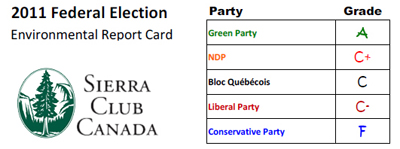
Sierra Club Canada releases its 2011 Federal Election Environmental Report Card


OTTAWA - In response to an overwhelming demand from members and supporters, Sierra Club Canada is today releasing its 2011 Election Report Card.
The five major parties are awarded grades based on their platforms, statements and actions.


The final grades are as follows:
Green Party: A
NDP: C+
Bloc: C
Liberals: C-
Conservatives: F
"Using and online survey tool, we asked our members what action we should take in the election," said John Bennett, Executive Director of Sierra Club Canada. "Over 1000 people responded in less than 48 hours - a strong majority of them requesting we provide information based on fair and accurate comparisons of the environmental positions of the parties."
The first draft of the Report Card was emailed to 12,000 supporters on Sunday, April 17 for their review and input.
"The feedback we received helped make the report card a much stronger document," said Bennett. "We have never seen such interest from our supporters. They are clearly disappointed the environment is not being discussed in this election."
The Election report Card was produced by experts, volunteers and staff from across Canada. The information provided by the parties was fairly compiled, scrutinized and judged against what needs to be done to protect Canada's natural environment.
The report card was not intended to be a comprehensive review of all the environmental issues of concern to Sierra Club Canada, but based on environmental policies touched on by the parties in this election.
"The report card was truly a cooperative, participatory effort from beginning to end. I want to thank everyone involved," said Mr. Bennett. "We look forward to the next opportunity to engage our grassroots supporters. They are a wealth of knowledge and an inspiration to us."
John Bennett, Executive Director
Sierra Club Canada
jb@sierraclub.ca
(613) 291-6888


Get the pictures and subscribe at: http://fundytides.blogspot.com
Enhanced by Zemanta

Sunday, October 31, 2010

ENVIRONMENT: Upper Fundy land returned to saltmarsh

Anyone living in upper Bay of Fundy is quite aware that large tracts of our coastal land are currently protected from tidal inundation by dykes. The original dykes were built by Acadian settlers over 350 years ago to convert salt water marshes to farm land.

Although these converted salt water marshes or "dykelands" remain some of the region's most fertile agricultural land, much of it today is underutilized: 15% of dykeland in Nova Scotia and 41% of dykeland in New Brunswick is no longer being farmed. 

It's estimated that 85% of the saltmarshes in the Bay of Fundy were lost due to dyking. With the pressures of climate change and rising sea levels, there certainly appears to be case to be made returning some of these unused dykelands to the Bay as salt marshes.

Ducks Unlimited launched an interesting project this week in upper Bay of Fundy: it intentionally returned 16 hectares of farmland to saltmarsh and will closely monitor how the restored saltmarsh can act as a buffer to rising sea levels and storm surges. It's also expected that salt marshes may ease the pressure on remaining dykes. 'Twill be interesting to watch...

From http://bayoffundy.blogspot.com/2010/10/upper-fundy-land-restored-to-saltmarsh.html

Sunday, May 16, 2010

Opinion - We are on a very fast track to hell itself

Get the pictures and subscribe at: http://fundytides.blogspot.com

The word is out there now on the true costs of fossil fuel addiction. It runs the gamut from deaths from gas explosions, deaths on oil rigs, deaths in coal mines, to major environmental catastrophes such as the oil spill in the Gulf which is in the process of destroying the local environment and economy and threatens to spread further, and the Alaskan Exxon Valdez spill, the destruction of the Niger Delta for export of LNG, the costs of global warming- which affects the entire planet, to the costs of the Oil Wars in the Middle East and the related costs of destabilization of global relationships ( ie: the World Trade Center ). How much does this add up to? What is the bottom line? Is it enough to get us to look seriously at changing our life styles to one more sustainable and to our working towards free renewable energy?

Addiction is a terrible thing, and we are addicted in the worst sense of the word. We are addicted to our outdated world view and our old materialistic habits and we resist sacrifice of the smallest sort. I first understood the power of addiction when I heard stories of children sold by parents for money to feed their heroin habits. Yet we are trashing the globe and sacrificing our children’s future to feed our fossil fuel addiction. How is that different? Where is the evidence for our claims of being an intelligent species?

What does it take to convince enough people that we are on a very fast track to hell itself on this planet? Massive disruptions will come faster and faster and on a more and more major scale because that is the nature of explosive population growth combined with explosive exploitation of resources- combined with unethical practices. Like true addicts we are in the process of throwing it all away for the quick fix.

We need a revolution in our world view and we need it right now. We need to wake up and see that this planet is the true home, the only possible home, of the human race. We need to see, value and understand the natural world and understand how we can work in harmony with the resources of the globe instead of exploiting them. We need a viewpoint that sees and understands the true costs of our actions. Only the mentally disturbed do not recognize the costs of their own actions. We need a revival of moral and ethical relationships within our communities, our countries and towards our environment. Nothing less than that will give our children a recognizable future world.

Joyce Morrell, Campobello

Photo Credit; wikipedia.com

Saturday, October 3, 2009

Canaport LNG to Invest in Restoring Wetlands in New Brunswick

Get the pictures and subscribe at: http://fundytides.blogspot.com


Posted: October 2, 2009

Canaport LNG has entered into a memorandum of understanding with the town of Hampton, New Brunswick, to restore a decommissioned lagoon that was used to process sewage effluent from nearby homes. The Telegraph-Journal reports that Canaport LNG must restore a total of approximately 48 hectares of wetlands to comply with provincial requirements and that this project will restore nearly 9 hectares.

From the LNG Law Blog