Tuesday, April 5, 2011

RADIATION: Could a nuclear accident impact local fisheries in the Bay of Fundy?

Well to get some idea, the Japanese reactors are dumping radioactive water into the Pacific, an open-ocean area, unlike our enclosed Bay. We should all watch this closely.

I must admit, I become somewhat sceptacle when the fox in the hen house says the fish over there have "acceptable" levels of I-131 and particularly radioactive cesium.

Oh by the way. "The Powers" reduced our sampling sites to only 3 ... 2 near the Point Lepreau reactor and one at Digby for air-borne emissions. Not sufficient! More on that later.

Art
****************************


Click on the flag for more information about JapanJAPAN 
Tuesday, April 05, 2011, 15:00 (GMT + 9)

Fishers in Fukushima Prefecture are asking the government to solve the problems at the Fukushima nuclear power plant and to prevent rumors by providing the public with accurate information. Meanwhile, Tokyo Electric Power Co (TEPCO) has begun pouring 10,000 tonnes of low-radioactive wastewater into the sea.

After hearing confirmation on Saturday that radioactive water was leaking into surrounding waters from the No 1 nuclear reactor, the fishers reiterated that rumors about all the seawater being contaminated could impair their livelihoods.

Head of the Soma-Futaba fishery association in Soma, Fukushima Prefecture, Fusayuki Nambu urged the government to release full details on the situation.


"We don't know what damage the radiation leak might cause, because assessment surveys haven't been conducted,” he stressed, reports The Yomiuri Shimbun. “This could give rise to dangerous rumors if people get the impression that all the seawater near Fukushima [Prefecture] is contaminated."

This weekend, three fishery associations in south-central Ibaraki Prefecture -- Oaraimachi, Kashimanada and Hasaki -- issued a statement assuring that the waters of southern Kashimanada are safe. They noted that radiation

Monday, April 4, 2011

RADIATION: Lepreau monitor picks up radioactivity from Japan

Published Saturday April 2nd, 2011
Nuclear: No health hazard to Canadians from infinitesimal amounts, watchdog says
A5
Ian MacLeod
Postmedia News

OTTAWA - Radiation monitors in Ontario, New Brunswick and British Columbia have detected minute traces of radioactive iodine suspected to be from Japan's stricken Fukushima nuclear plant.

The Canadian Nuclear Safety Commission characterizes the quantities of Iodine-131 (I-131) as infinitesimal and stresses there are no health hazards to Canadians.

Bruce Power, operator of the Bruce nuclear generating station on the shores of Lake Huron northwest of Toronto, recently reported traces of airborne I-131 in a small number of monitoring samples.

"It has been concluded that this I-131 is likely due to the result of emissions of I-131 from the Fukushima plant in Japan," the commission said in a news release.

I-131 is produced by the fission of uranium atoms in nuclear reactors and by plutonium (or uranium) in the detonation of nuclear weapons.

Analysis of the Bruce Power samples, taken in mid- to late-March, indicate the effective dose to a person would be approximately 0.03 of a microsievert if a person breathed in this concentration of air, and was exposed externally to this air for an entire month, said the commission. And that does not take into account the radioactive decay that would occur during that time. I-131 has a half-life of eight days.

A sievert measures the biological effect of radiation absorbed. A microsievert is one-millionth of a sievert. A millisievert is one one-thousandth.

On average, Canadians receive about 2.7 millisieverts of ionizing radiation from natural sources in a year.

By comparison, the I-131 detected by Bruce Power corresponds to 0.003 per cent of the CNSC's effective dose limit of one millisievert per year to a member of the public and is an even smaller percentage of the total effective dose from all sources of radiation to which Canadians are exposed.

"The presence of these concentrations of I-131 in the air will not produce harmful effects to the health of Canadians," the commission said.

NB Power, operator of the Point Lepreau nuclear generating station, recently detected even smaller amounts of I-131. Researchers at Simon Fraser University also report finding trace amounts in seaweed and rainwater around Vancouver.

Health Canada sets the safe maximum annual exposure for nuclear workers at 50 millisieverts, 100,000 times the level of Japanese radiation monitored in British Columbia, for example. To put this in perspective, you'll get 0.0001 millisieverts just from eating a banana, about the same as walking through an airport security scanner. And you'd have to walk through 1,000 airport security scans to equal your average chest X-ray.

Get the pictures and subscribe at: http://fundytides.blogspot.com
Enhanced by Zemanta

Friday, April 1, 2011

OPINION: WHY IS THE ALWARD GOVERNMENT AND THE NB MEDIA SO SILENT ON WHAT THE JAPAN NUCLEAR DISASTER MEANS FOR NEW BRUNSWICKERS?

Received by email today. Thanks Brook. Good points.
************************
THE NB GRIST MILL April 1, 2011 A New Brunswick Political Newsletter

 
WHY IS THE ALWARD GOVERNMENT AND THE NB MEDIA SO SILENT
ON WHAT THE JAPAN NUCLEAR DISASTER MEANS FOR NEW BRUNSWICKERS?
 
It would not be alarmist for our government to discuss the radiation risk potential of Point Lepreau -- it would be prudent, honest and logical -- given the global concern and the absolute game-changing repurcussions of the Japan Nuclear disaster. But it appears the Alward Government and the New Brunswick Media Community, for some reason, are avoiding this critically important issue to the New Brunswick public. Why is that?

The following (National Public Radio) story should be considered by our politicians and media from a New Brunswick perspective for the future of all New Brunswickers. It surely must give our leaders and media pause, at the very least? Perhaps they will be motivated to begin a discussion on the future of nuclear in New Brunswick? They have a responsibility, as our leaders, to talk about the future of nuclear energy in New Brunswick !

Think about this Quote from the story below: "Essentially, when you reach the Fukushima Dai-ichi stage, the question is, 'Are you prepared for things you haven't predicted?' And the answer is, 'How can you tell?' " he says. "We're certainly prepared for some things we haven't predicted, but [we're not sure] what it is we're preparing for."

Lekhaim from the Gristmill

On today's Fresh Air, New York Times energy reporter Matthew Wald joins Terry Gross for a wide-ranging conversation about the history — and future — of nuclear energy in the United States. Though storage and safety mechanisms are in place, he says, many unknown variables exist that are nearly impossible for regulators to forecast.
Listen to the story here:
 

The Future Of Nuclear Energy In The U.S.

March 31, 2011
A view of the Three Mile Island power plant near Harrisburg, Pa., site of the worst nuclear accident in U.S. history. In 1979, a reactor at the plant experienced a partial meltdown, but radioactive material never escaped containment.
Enlarge Bradley Bower/AP Photo A view of the Three Mile Island power plant near Harrisburg, Pa., site of the worst nuclear accident in U.S. history. In 1979, a reactor at the plant experienced a partial meltdown, but radioactive material never escaped

RADIATION: Another "couldn't happen" happens in BC

Power lines near the Point Lepreau (New Brunsw...
Some may remember my posts about iodine-131 in dulse in the Bay of Fundy. Four points: 1. It can and probably has happened here in NB. 2. The "half-life" is the time (8days) it takes to lose half its radioactivity. BUT it takes another 8 days to lose half of the remaining half and so on and so on. 3. The danger comes from the initial level (concentration) that is taken up by the seaweed. 4. Most radionuclides become deadly when ingested, particularly i-131 which concentrates in the thyroid.

And the officials continue to say the Japan nuclear disaster will not impact their plans for Lepreau.

My thoughts this morning.

Art

******************************
Radioactive material found in B.C. seaweed and rainwater


Low levels of iodine-131 found in B.C. seaweed

Andrea Stockton, staff writer, The Weather Network

March 29, 2011 — Samples taken from rainwater and seaweed in B.C. show low levels of radiation from the damaged nuclear reactor in Japan.


Iodine-131 has a half life of eight days

A research team at Simon Fraser University (SFU) in B.C. say there has been a slight increase in radioactive material in samples of seaweed and rainwater on the west coast.

The rainwater was collected from the campus on Burnaby Mountain and the seaweed was taken near the SeaBus Terminal in North Vancouver. In a news release from SFU, scientists said the radiation from Japan's damaged nuclear reactor was carried by the jet stream and is mixing with sea water and accumulating in seaweed. The same material was detected on March 19, 20 and 25.

Although the team has detected an increase in iodine-131, which is sent into the atmosphere after a nuclear fission, health officials continue to stress that the levels are extremely low and are not a current threat to humans. Iodine-131 has a half life of eight days, so officials say it has a very rapid decay. It is usually used in the medical and pharmaceutical industries.

Since March 11, when the 9.0 magnitude earthquake and following tsunami devastated Japan, it has been a struggle to cool the Fukushima nuclear plant. Scientists predict that iodine-131 will be detected in B.C. for three to four weeks after the Fukushima reactor completely stops releasing radioactivity into the atmosphere.

With files from The Canadian Press and The Vancouver Sun
Image via Wikipedia
Get the pictures and subscribe at: http://fundytides.blogspot.com
Enhanced by Zemanta

Monday, March 28, 2011

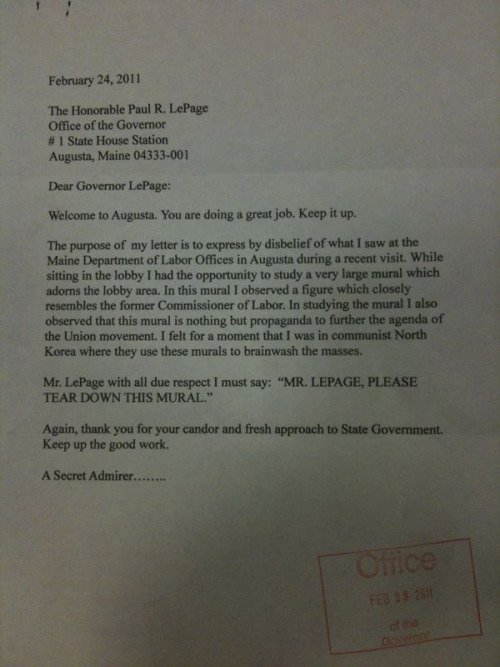
ISSUES: LePage removes historic Mural over weekend ... calls protestors "idiots".


Mural removed over weekend from Department of Labor offices
By Kevin Miller, BDN Staff
Posted March 28, 2011, at 10:22 a.m.
Last modified March 28, 2011, at 11:23 a.m.

AUGUSTA, Maine — A labor-themed mural that has become a flashpoint between Gov. Paul LePage, unions and Maine artists was removed from its prominent location in a state building over the weekend, administration officials confirmed Monday.

Administration spokespersons Dan Demeritt and Adrienne Bennett would not say when, exactly, crews took down the 11-panel mural depicting the history Maine’s labor movement.

“It is safely in storage and we are anticipating its relocation to a more appropriate location,” Demeritt said Monday morning.

Friday, more than 200 protesters gathered at the Department of Labor building in Augusta to show their opposition to the removal of the 3-year-old mural. Some in the crowd said they would employ non-violent tactics of civil disobedience to block the mural’s removal. LePage responded, in an interview with WCSH6, by saying if protesters formed a human chain around the mural as they were planning, “I’d laugh at them, the idiots. That’s what I would do. Come on! Get over yourselves!”

“The Department of Labor has an important job to do for workers and employers and we just didn’t have time for distractions,” Demeritt said.

The LePage administration decided to remove the mural after receiving a handful of complaints from citizens and business owners who viewed it as too pro-union for a department that is responsible for working with both employers and employees. The painting’s defenders, meanwhile, describe it as a piece of art that depicts important events, themes and figures in Maine’s labor history.

Portland officials have indicated they might be willing to house the mural in City Hall, but such a move would have to be approved by the City Council.


Get the pictures and subscribe at: http://fundytides.blogspot.com

Sunday, March 27, 2011

ENERGY: Get to know your neighbourhood radionuclides.

Electron shell 094 PlutoniumImage via Wikipedia

Commonly Encountered Radionuclides

Approximately 2,300 nuclides have been identified; most of them are radioactive.

Which nuclides are radioactive?

Unstable nuclides of any element can exist. However, almost all elements that are heavier than bismuth, which has 83 protons, have an unstable nucleus; they are radioactive and are known as "heavy nuclides." Nuclides with fewer than 83 protons are known as "light nuclides."
While there are hundreds of radionuclides, many of them are rarely encountered. People are much more likely to encounter a few that are used routinely for medical, military, or commercial purposes. The list below and accompanying fact sheets discuss twelve radionuclides. They are the ones most commonly used and most commonly found in Superfund Sites.
Please note: Where an element is listed rather than an individual radionuclide, the element has several radioactive isotopes of interest:
Fact Sheets on Commonly Encountered Radionuclides
 Radiation Type
NameAtomic NumberAlphaBetaGamma
americium-24195Americium is primarily an alpha particle emitter. It also emits some gamma rays. Americium primarily emits alpha particles, but also emits some gamma rays.
cesium-13755 Cesium-137 is a beta particle emitter.Cesium-137 is a gamma emitter.
cobalt-6027 Cobalt-60 is a beta particle emitter.Cobalt-60 is a gamma emitter.
iodine-129 &-131 53 Iodine-129 and -131 are beta particle emittersIodine-129 and -131 are gamma ray emitters
plutonium94Most plutonium isotopes are alpha particle emitters; some emit other forms of radiation.Most plutonium isotopes are alpha particle emitters; some emit other forms of radiation.Most plutonium isotopes are alpha particle emitters; some emit other forms of radiation.
radium88Radium isotopes are alpha particle emitters. Radium isotopes are also gamma ray emitters.
radon86The isotopes of radon are alpha particle emitters.  
strontium-9038 Strontium-90 is a beta particle emitter.  
technetium-9943 Technitium-99 is a beta particle emitter. Technitium-99m  is a gamma emitter.
tritium * 1 Tritium is a beta particle emitter.  
thorium90Thorium emits alpha particles with gamma rays Thorium emits alpha particles with gamma rays
uranium92Uranium is an alpha particle emitter. Uranium is a gamma ray emitter.
* tritium is a specific isotope, H-3.

Get the pictures and subscribe at: http://fundytides.blogspot.com
Enhanced by Zemanta

Saturday, March 19, 2011

ENERGY: Ralph Nader on our Nuclear Nightmare ... who will pay and why.


Nuclear Nightmare

The unfolding multiple nuclear reactor catastrophe in Japan is prompting overdue attention to the 104 nuclear plants in the United States—many of them aging, many of them near earthquake faults, some on the west coast exposed to potential tsunamis.

Nuclear power plants boil water to produce steam to turn turbines that generate electricity. Nuclear power’s overly complex fuel cycle begins with uranium mines and ends with deadly radioactive wastes for which there still are no permanent storage facilities to contain them for tens of thousands of years.

Atomic power plants generate 20 percent of the nation’s electricity. Over forty years ago, the industry’s promoter and regulator, the Atomic Energy Commission estimated that a full nuclear meltdown could contaminate an area “the size of Pennsylvania” and cause massive casualties. You, the taxpayers, have heavily subsidized nuclear power research, development, and promotion from day one with tens of billions of dollars.

Because of many costs, perils, close calls at various reactors, and the partial meltdown at the Three Mile Island plant in Pennsylvania in 1979, there has not been a nuclear power plant built in the United States since 1974.

Now the industry is coming back “on your back” claiming it will help reduce global warming from fossil fuel emitted greenhouse gases.

Pushed aggressively by President Obama and Energy Secretary Chu, who refuses to meet with longtime nuclear industry critics, here is what “on your back” means:

1. Wall Street will not finance new nuclear plants without a 100% taxpayer loan guarantee. Too risky. That’s a lot

March 19, 2011… “SuperMoon” or “SuperHype”?

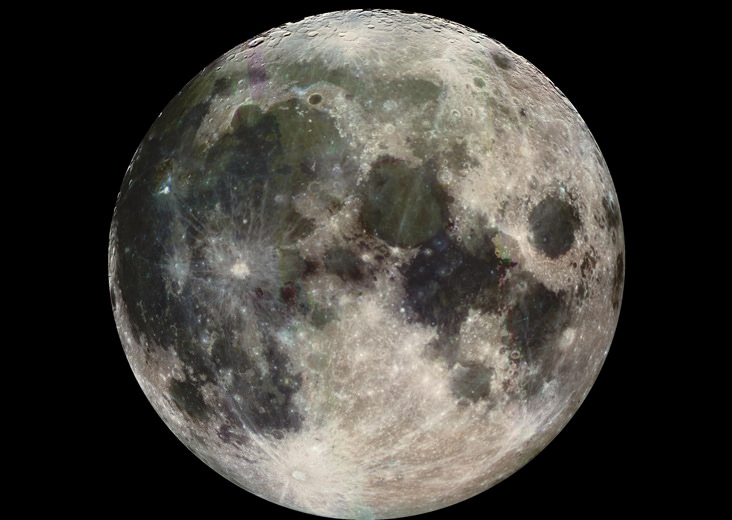
Watch to the east tonight as the Supermoon rises. Highest tide ... highest seismic risk.
**********************
by TAMMY PLOTNER on MARCH 10, 2011


Credit: JPL/NASA

I mean no disrespect for those who enjoy the study of astrology. Some of the greatest astronomers of the past were also astrologers. To practice either line requires a deep understanding of our solar system, its movements and the relationship to the celestial sphere. The only thing I have difficulty swallowing is how a perfectly normal function could wreak havoc on planet Earth. Does an astrological prediction of an upcoming “Extreme SuperMoon” spell impending disaster – or is it just one more attempt to excite our natural tendencies to love a good gloom and doom story? That’s what I set about to find out…

On March 19, 2011 the Moon will pass by Earth at a distance of 356,577 kilometers (221,567 miles) – the closest pass in 18 years . In my world, this is known as lunar perigee and a normal lunar perigee averaging a distance of 364,397 kilometers (226,425 miles) happens… well… like clockwork once every orbital period. According to astrologer, Richard Nolle, this month’s closer than average pass is called an Extreme SuperMoon. “SuperMoon is a word I coined in a 1979 article for Dell Publishing Company’s HOROSCOPE magazine, describing what is technically termed a perigee-syzygy; i.e. a new or full Moon (syzygy) which occurs with the Moon at or near (within 90% of) its closest approach to Earth (perigee) in a given orbit.” says Richard. “In short, Earth, Moon and Sun are all in a line, with Moon in its nearest approach to Earth.”

Opinions aside, it is a scientific fact when the Moon is at perigee there is more gravitational pull, creating higher tides or significant variations in high and low tides. In addition, the tidal effect of the Sun’s gravitational field increases the Moon’s orbital eccentricity when the orbit’s major axis is aligned with the Sun-Earth vector. Or, more specifically, when the Moon is full or new. We are all aware of Earth’s tidal bulges. The average tidal bulge closely follows the Moon in its orbit, and the Earth rotates under this tidal bulge in just over a day. However, the rotation drags the position of the tidal bulge ahead of the position directly under the Moon. It produces torque… But is it above average torque when the Moon is closer? It you ask a geologist, they’ll tell you no. If you ask an astronomer, they’ll tell you that just about any cataclysmic Earth event can be related to stars. But if you ask me, I’ll tell you that you should draw your own opinion. Even the American Meteorlogical Society states: “Tidal forces contribute to ocean currents, which moderate global temperatures by transporting heat energy toward the poles. It has been suggested that in addition to other factors, harmonic beat variations in tidal forcing may contribute to climate changes.”


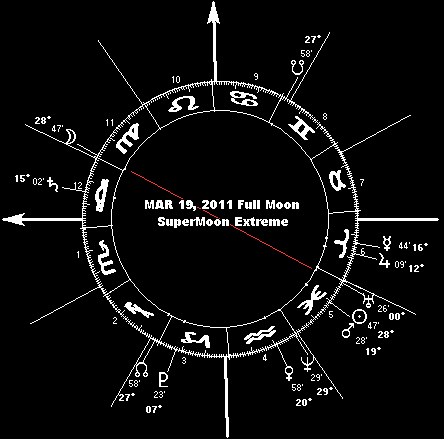
Credit: Richard Nolle“SuperMoons are noteworthy for their close association with extreme tidal forces working in what astrologers of old used to call the sublunary world: the atmosphere, crust and oceans of our home planet – including ourselves, of course. From extreme coastal tides to severe storms to powerful earthquakes and volcanic eruptions, the entire natural world surges and spasms under the sway of the SuperMoon alignment – within three days either way of the exact syzygy, as a general rule.” says Nolle. “Obviously it won’t be the case that all hell will break loose all over the world within a few days either side of the SuperMoons. For most of us, the geocosmic risk raised by SuperMoon alignments will pass with little notice in our immediate vicinity. This is a rather roomy planet, after all. But the fact remains that a SuperMoon is planetary in scale, being a special alignment of Earth, Sun and Moon. It’s likewise planetary in scope, in the sense that there’s no place on Earth not subject to the tidal force of the perigee-syzygy.”

If you take the time to really look at Nolle’s work, you’ll find that he does not believe earthquakes and volcanic eruptions go wandering all over the planet. They happen in predictable locations, like the infamous “Ring of Fire” around the Pacific plate. “If you’re in (or plan to be in) a place that’s subject to seismic upheaval during a SuperMoon stress window, it’s not hard to figure out that being prepared to the extent that you can is not a bad idea. Likewise, people on the coast should be prepared for extreme tidal surges. Severe storms on the other hand can strike just about anywhere, so it behooves us all to be ready for rough weather when a SuperMoon alignment forms.”

Does this mean I’m about to buy into astrology? Not hardly. But what I do believe in is respect for other’s work and opinions. It’s very obvious that Nolle has done his astronomy homework – as well as paying close attention to current political and social situations. “That said, there’s no harm in making sensible preparations for this year’s SuperMoons.” quips Richard. “The worst that can happen, if the worst doesn’t happen, is that you end up with a stock of fresh batteries and candles, some extra bottled water and canned goods, maybe a full tank of gas and an evacuation bag packed just in case. (The US Department of Homeland Security has a detailed evacuation kit inventory that, to quote them, “could mean the difference between life and death”.) And maybe you’ll think twice about being in transit and vulnerable to the weather hazards and delays that are so common during SuperMoon alignments. These are the kind of sensible precautions that can make a big difference if the worst does come to pass.”

What do I believe will happen during an Extreme SuperMoon? I think if we aren’t having two snowstorms followed by a nocturnal tornado and then chased down by a week of flooding in Ohio, that the March Worm Moon will appear to be about 30% brighter and about 15% larger than a “normal” full Moon. If I were an astrophotographer, I’d be getting out my camera (and hip waders) to do a few comparison shots with upcoming full Moons. But considering all things are equal?

I think I’ll just stay home.

Be sure to visit Richard Nolle’s page SuperMoon for more insight!


Get the pictures and subscribe at: http://fundytides.blogspot.com

Thursday, March 17, 2011

NUCLEAR CONCERNS: Report outlines problems at Diablo Canyon nuclear power plant

Report outlines problems at Diablo Canyon nuclear power plant

March 17, 2011 | 2:28 pm


The reactor at Diablo Canyon nuclear power plant in San Luis Obispo operated for a year and a half with some emergency systems disabled, according to a 2010 safety review by the federal Nuclear Regulatory Commission.

The incident was one of 14 “near-misses” the NRC uncovered in its inspections of nuclear power plants where problems had been occurring. An analysis by the group Union of Concerned Scientists concluded that “many of these significant events occurred because reactor owners, and often the NRC, tolerated known safety problems.”

The NRC found a range of problems at the 14 plants, including poor design, equipment failure, poor training and human error.

The issue at the Diablo Canyon plant, which is operated by Pacific Gas & Electric, involved malfunctioning valves that prevented other valves from opening. The valves were improperly repaired and subsequent tests failed to detect the problem, according to the report.

Analysis by the Union of Concerned Scientists found that the NRC’s inspections suggest that nuclear plants “continue to experience problems with safety-related equipment and worker errors that increase the risk of damage to the reactor core.”

The UCS report also cited three instances in which NRC inspectors aggressively pursued power plant operators to enforce safety standards.

-- Julie Cart

Photo: Diablo Canyon nuclear power plant. Credit: Los Angeles Times

Get the pictures and subscribe at: http://fundytides.blogspot.com
Enhanced by Zemanta

ENERGY:Nuclear Power Plants in Canada.

For the record. Here is a list of all Canadian nuclear reactors.


Courtesy Canadian Nuclear Society

On the map, circles represent research reactors, triangles represent commercial facilities. Please refer to CNS' site map for more detail.

Research 1-Univ Alberta, Edmonton (S), 2-Saskatchewan Research Council, Saskatoon (S), 3-AECL Whiteshell (WR-1, S Demo), 4-McMaster Univ, Hamilton (P), 5-Univ. Toronto (S), 6-Royal Military College, Kingston (S), 7-AECL Chalk River Laboratories (NRU, NRX, PTR, ZED-2, ZEEP), 8-Nordion, Kanata (S), 9-Ecole Polytechnique, Montreal (S), 10-Dalhousie Univ., Halifax (S). S=Slowpoke II (20 kw); P=Swimming Pool (5 MW). AECL's Whiteshell reactors and Chalk River NRX and ZEEP reactors are shutdown.

Commercial 1-Bruce and Douglas Point, 2-Pickering, 3-Darlington, 4-Gentilly, 5-Point Lepreau, 6-NPD. Douglas Point, Gentilly 1, and NPD have been decommissioned; Bruce A2 is mothballed.

Canada has focused on the CANDU (Canadian Deuterium-Uranium) design, which uses heavy water as the moderator and coolant and natural uranium as the fuel. Canadian companies operating the reactors are - Ontario Power Generation (Nuclear division), Bruce Power, and Quebec Hydro - and the New Brunswick Power Commission operate the commercial facilities.

Canadian nuclear reactors are regulated by the Canadian Nuclear Safety Commission (CNSC), the successor to the former Atomic Energy Control Board (AECB)

More information here.

Get the pictures and subscribe at: http://fundytides.blogspot.com